
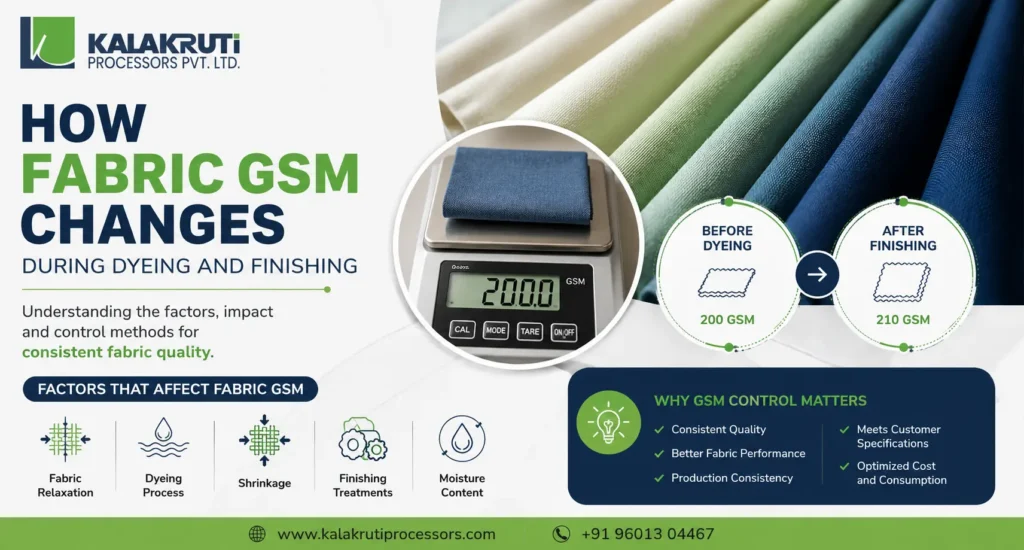
How Fabric GSM Changes During Dyeing and Finishing
Fabric GSM (Grams per Square Meter) is an important quality parameter in textile manufacturing. It indicates the weight of fabric per square meter and directly affects its feel, thickness, drape, durability, and end use.
During dyeing and finishing, fabric GSM can change due to several physical and chemical processes. Understanding these changes helps textile manufacturers maintain consistent fabric quality and meet customer specifications.
What Causes GSM to Change During Dyeing?
Fabric GSM can increase or decrease during different stages of processing. Some of the major factors include:
1. Fabric Relaxation
Knitted and woven fabrics may relax when exposed to water, heat, and chemicals. This can change the fabric’s dimensions and consequently affect its GSM.
2. Dyeing Process
During dyeing, fabric absorbs water, dyes, and processing chemicals. While most of the water is removed during drying, the structure of the fabric may change, resulting in variations in GSM.
3. Shrinkage
If fabric shrinks in length or width during dyeing and finishing, its weight per square meter can increase. This is why fabric shrinkage and GSM are closely connected.
4. Finishing Treatments
Processes such as compacting, calendaring, softening, raising, and coating can significantly influence fabric GSM. For example, compacting can increase GSM by reducing fabric dimensions.
5. Moisture Content
GSM testing should be performed under controlled moisture conditions. Different moisture levels in fabric can lead to inconsistent GSM readings.
Why GSM Control Matters
Maintaining the correct GSM is essential for consistent textile quality. Incorrect GSM can affect:
- Fabric hand feel and appearance
- Garment fitting and performance
- Production consistency
- Customer specifications
- Cost and fabric consumption
At Kalakruti Processors Pvt. Ltd., careful control of dyeing and finishing parameters helps achieve consistent fabric quality while meeting the required specifications.
How Can GSM Variations Be Controlled?
Accurate GSM control starts with proper testing of greige fabric and continues throughout processing. Monitoring shrinkage, controlling temperature and chemical conditions, maintaining proper drying parameters, and checking finished fabric GSM can help reduce unwanted variations.
Regular quality checks at different processing stages also help identify deviations early and maintain consistency from batch to batch.
FAQs
Does dyeing increase fabric GSM?
Dyeing itself does not always increase GSM. Changes in fabric dimensions, shrinkage, moisture, and subsequent finishing processes can cause GSM to increase or decrease.
Why does GSM increase after finishing?
GSM may increase after finishing when the fabric shrinks or is compacted, reducing its area while retaining approximately the same fabric weight.
How is fabric GSM measured?
GSM is generally measured by cutting a fabric sample of a known area and weighing it. The weight is then converted into grams per square meter.
Why is GSM important in fabric processing?
GSM helps determine fabric weight, thickness, feel, performance, and suitability for different applications. Consistent GSM is therefore an important part of textile quality control.