
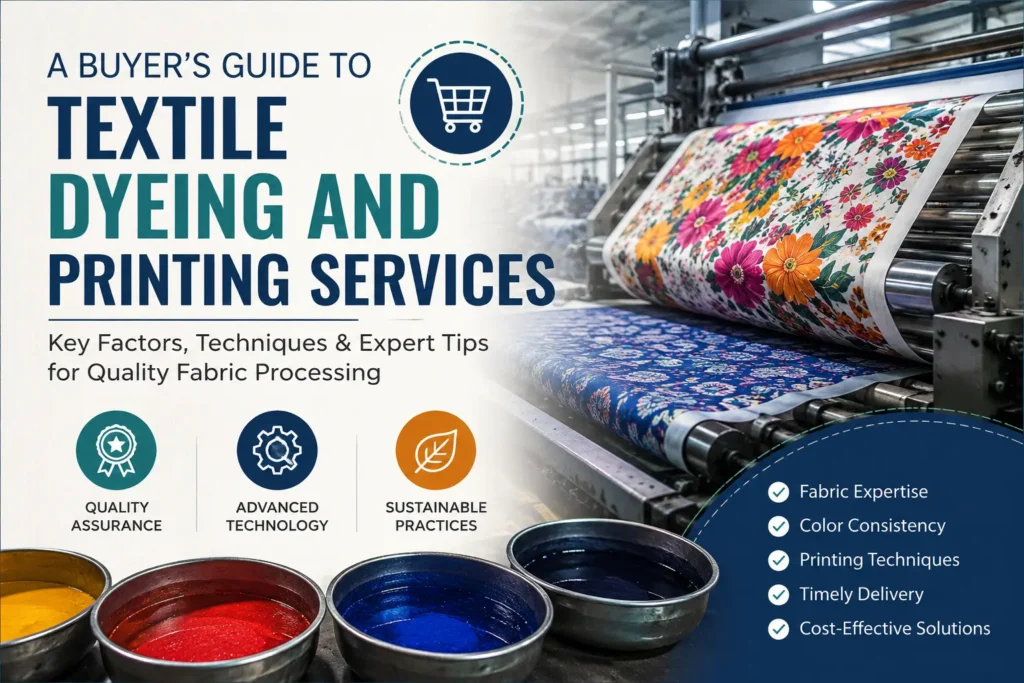
A Buyer’s Guide to Textile Dyeing and Printing Services
In the textile industry, the quality of dyeing and printing plays a crucial role in determining the final appearance, durability, and market value of a fabric. Whether you’re a garment manufacturer, fashion brand, textile exporter, or fabric wholesaler, choosing the right textile dyeing and printing partner can significantly impact your product quality and customer satisfaction.
This buyer’s guide will help you understand the key factors to consider when selecting textile dyeing and printing services and how to ensure you get consistent, high-quality results for your fabric requirements.
Understanding Textile Dyeing and Printing
Before choosing a processing partner, it is important to understand the difference between dyeing and printing.
Textile Dyeing
Dyeing is the process of applying color uniformly across the entire fabric. It ensures consistency, color fastness, and durability while maintaining the fabric’s texture and quality.
Textile Printing
Printing involves applying designs, patterns, or motifs onto the fabric surface. Modern printing techniques allow manufacturers to create intricate designs, vibrant colors, and customized patterns for various fashion and home textile applications.
Why Choosing the Right Processing Partner Matters
A reliable textile dyeing and printing company can provide:
- Consistent color matching
- High-quality fabric finishing
- Timely order completion
- Reduced fabric wastage
- Better product durability
- Enhanced customer satisfaction
- Compliance with export standards
Choosing the wrong partner can lead to color inconsistencies, delayed deliveries, quality issues, and increased production costs.
Key Factors to Consider When Selecting Textile Dyeing and Printing Services
1. Production Capacity
Evaluate whether the company can handle your order volume efficiently. Large-scale production facilities with modern machinery can process bulk orders while maintaining consistency.
Look for:
- Daily production capacity
- Ability to handle bulk orders
- Scalability for growing business needs
2. Technology and Machinery
Advanced machinery ensures precision, efficiency, and superior output quality.
Consider companies that utilize:
- Reactive dyeing technology
- Pigment printing systems
- Digital textile printing
- Rotary printing machines
- Automated quality control systems
Modern equipment reduces errors and improves color accuracy.
3. Fabric Expertise
Different fabrics require different processing techniques.
Choose a service provider experienced in handling:
- Cotton fabrics
- Rayon fabrics
- Polyester fabrics
- Viscose fabrics
- Linen fabrics
- Blended textiles
Fabric-specific expertise ensures optimal results and minimizes damage during processing.
4. Color Consistency and Matching
Color consistency is one of the most critical aspects of textile processing.
Ask potential suppliers:
- How they maintain color standards
- Whether they provide lab dip approvals
- Their color matching process
- Quality control measures in place
Reliable processors ensure uniform color reproduction across production batches.
5. Printing Capabilities
If you require printed fabrics, assess the company’s design and printing capabilities.
Check for:
- Custom design development
- Digital printing options
- Screen printing services
- Rotary printing solutions
- Multi-color printing capabilities
The right partner should be able to translate creative concepts into high-quality fabric prints.
Why Businesses Prefer Professional Textile Processors
Professional textile processing companies provide:
- Consistent production quality
- Advanced machinery
- Technical expertise
- Better color management
- Faster turnaround times
- Cost-efficient bulk processing
For textile manufacturers and exporters, partnering with an experienced processor helps maintain competitiveness in demanding markets.
Conclusion
Selecting the right textile dyeing and printing service provider is a critical business decision that directly impacts product quality, customer satisfaction, and profitability. By evaluating factors such as production capacity, technology, quality control, fabric expertise, and delivery performance, buyers can make informed decisions and build long-term partnerships with reliable textile processors.
At Kalakruti Processors, we understand the importance of quality, consistency, and innovation in textile processing. Our commitment to advanced dyeing and printing solutions helps businesses achieve exceptional fabric results while meeting industry standards and customer expectations.
Frequently Asked Questions (FAQs)
1. What is the difference between textile dyeing and textile printing?
Textile dyeing colors the entire fabric uniformly, while textile printing applies specific patterns or designs onto the fabric surface.
2. Which printing method is best for detailed fabric designs?
Digital textile printing is ideal for highly detailed and multi-colored designs with excellent precision.
3. Why is color fastness important in textile dyeing?
Color fastness ensures that fabric colors remain vibrant and do not fade during washing, sunlight exposure, or regular use.
4. How do I choose a reliable textile dyeing and printing company?
Evaluate factors such as experience, machinery, quality control systems, production capacity, turnaround time, and customer reviews.
5. Can dyeing and printing services handle bulk textile orders?
Yes, professional textile processors are equipped to manage large-scale orders while maintaining quality and consistency.
6. What fabrics can be dyed and printed?
Common fabrics include cotton, rayon, polyester, viscose, linen, silk, and various blended textiles.
7. Why should exporters work with experienced textile processors?
Experienced processors ensure compliance with international quality standards, consistent production quality, and timely delivery for export markets.