
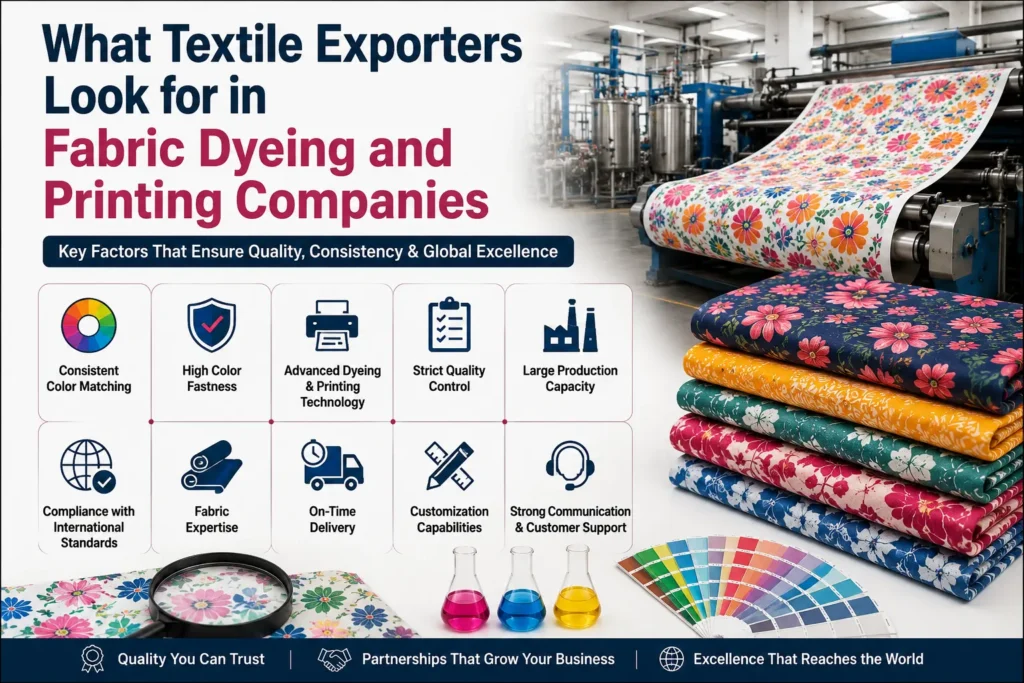
What Textile Exporters Look for in Fabric Dyeing and Printing Companies
The global textile industry is highly competitive, and exporters must meet strict quality standards, delivery schedules, and customer expectations. Whether supplying fabrics to fashion brands, garment manufacturers, home textile companies, or international retailers, the quality of fabric dyeing and printing plays a crucial role in the success of export businesses.
For textile exporters, selecting the right dyeing and printing partner is more than a sourcing decision—it is a strategic business investment. A reliable processing company ensures consistent quality, compliance with international standards, and timely delivery.
In this blog, we’ll explore the key factors textile exporters look for when choosing fabric dyeing and printing companies and why these capabilities are essential for global market success.
Why Dyeing and Printing Quality Matters in Textile Exports
Fabric dyeing and printing directly affect:
- Product appearance
- Color consistency
- Brand reputation
- Customer satisfaction
- Export acceptance rates
Even minor variations in shade, print alignment, or fabric quality can result in rejected shipments, financial losses, and damaged client relationships.
This is why exporters prioritize dyeing and printing partners that consistently deliver high-quality results.
Key Factors Textile Exporters Look For
1. Consistent Color Matching
Color consistency is one of the most important requirements in export markets.
International buyers expect fabrics to maintain identical shades across:
- Multiple production batches
- Repeat orders
- Different shipment schedules
Professional dyeing companies utilize advanced color matching systems and laboratory testing to ensure uniformity throughout production.
2. High Color Fastness Standards
Export-quality fabrics must withstand:
- Frequent washing
- Rubbing and abrasion
- Sunlight exposure
- Daily usage
Textile exporters often require strong performance in:
- Wash fastness
- Rubbing fastness
- Light fastness
- Perspiration fastness
Reliable dyeing and printing companies conduct thorough testing to meet international buyer specifications.
3. Advanced Dyeing and Printing Technology
Modern technology improves both quality and production efficiency.
Exporters typically prefer companies that offer:
Reactive Dyeing
Ideal for cotton fabrics and known for excellent color durability.
Pigment Printing
Versatile and suitable for various fabric types.
Digital Textile Printing
Provides high-resolution designs and rapid customization.
Rotary Screen Printing
Supports large-volume production with consistent quality.
Advanced equipment helps reduce defects and ensures better product performance.
4. Quality Control Systems
A robust quality management process is essential for export success.
Leading dyeing and printing companies implement:
- In-process inspections
- Shade approvals
- Fabric testing
- Print alignment checks
- Final quality audits
Strong quality control minimizes errors and ensures fabrics meet buyer expectations.
5. Large Production Capacity
Export orders often involve significant quantities and tight timelines.
Textile exporters prefer manufacturing partners capable of handling:
- Bulk production
- Continuous processing
- Multiple fabric categories
- Seasonal demand fluctuations
Adequate production capacity helps prevent delays and ensures smooth order fulfillment.
Benefits of Partnering with the Right Dyeing and Printing Company
Choosing the right processing partner offers several advantages:
- Consistent product quality
- Improved buyer satisfaction
- Reduced shipment rejections
- Better brand reputation
- Increased export opportunities
- Long-term business growth
A dependable dyeing and printing company becomes an extension of the exporter’s supply chain.
Why Textile Exporters Prioritize Long-Term Partnerships
Successful exporters understand that quality consistency is difficult to achieve without reliable manufacturing partners.
Long-term relationships with trusted dyeing and printing companies provide:
- Better production planning
- Faster order execution
- Consistent quality standards
- Improved cost efficiency
- Greater market competitiveness
These partnerships help exporters build stronger relationships with international buyers.
Conclusion
The success of textile exports depends heavily on the quality, consistency, and reliability of fabric dyeing and printing processes. Exporters seek partners that offer advanced technology, strict quality control, strong production capacity, and compliance with international standards.
By working with experienced dyeing and printing companies, textile exporters can meet global buyer expectations, reduce operational risks, and strengthen their position in international markets.
As competition in the textile industry continues to grow, selecting the right fabric processing partner remains one of the most important decisions for export success.
Frequently Asked Questions (FAQs)
1. Why do textile exporters need reliable dyeing and printing companies?
Reliable partners ensure consistent quality, timely delivery, and compliance with international buyer requirements.
2. What is the most important factor exporters look for in fabric dyeing companies?
Color consistency and quality control are among the top priorities for textile exporters.
3. Why is color fastness important for export fabrics?
High color fastness ensures fabrics maintain their appearance after washing, sunlight exposure, and daily use.
4. Which printing method is best for export-quality fabrics?
The ideal method depends on the fabric and application, but digital, reactive, and rotary printing are commonly used for export markets.
5. How do dyeing and printing companies ensure quality?
They conduct laboratory testing, in-process inspections, shade matching, and final quality audits.
6. Why is production capacity important for textile exporters?
Large production capacity allows manufacturers to handle bulk export orders efficiently and meet delivery deadlines.
7. What role does compliance play in textile exports?
Compliance with international standards helps exporters meet buyer requirements and access global markets.
8. How can exporters evaluate a dyeing and printing company?
They should assess quality systems, technology, certifications, production capacity, and delivery performance.